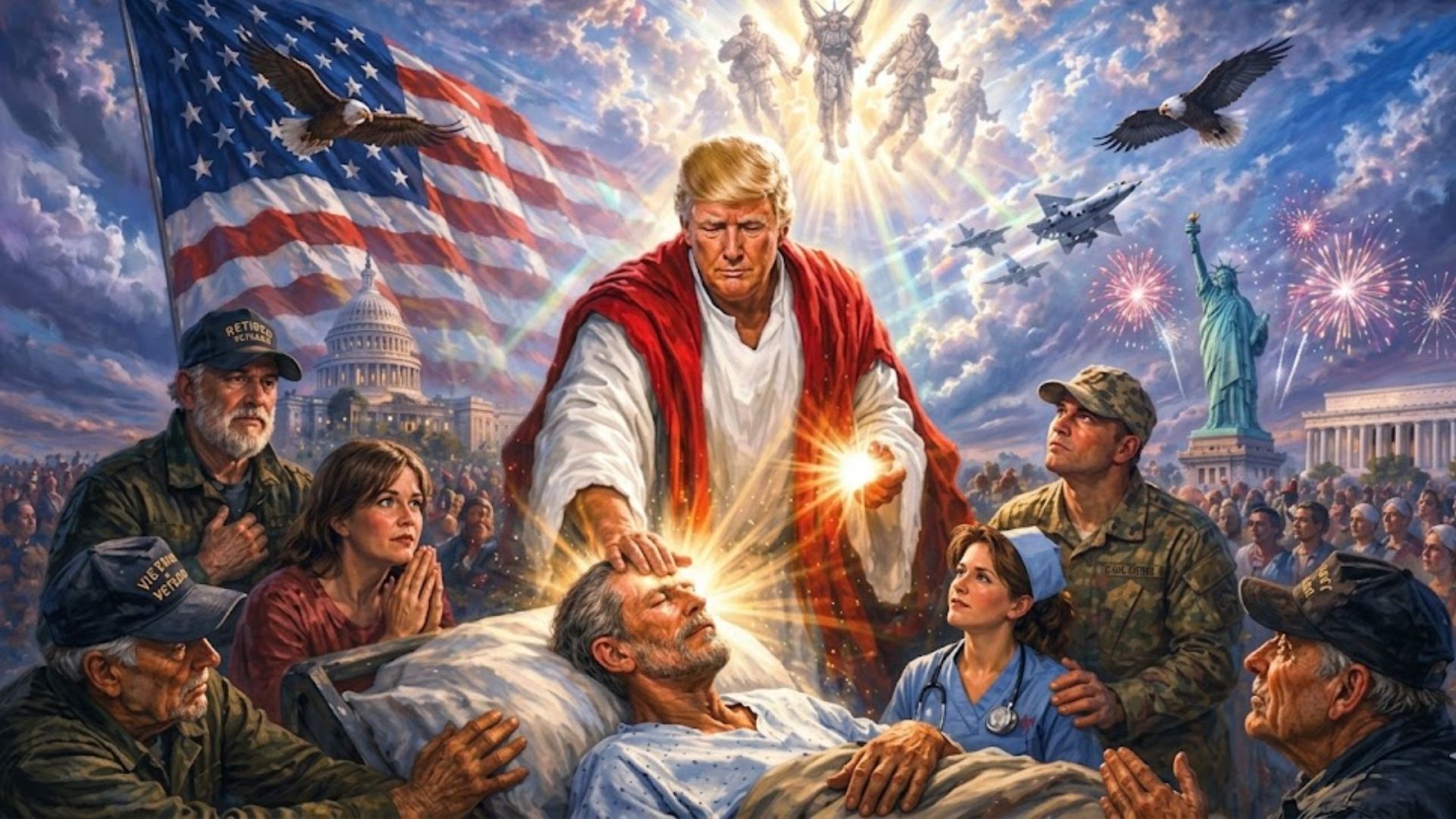
Trump as Jesus-The phrase Trump as Jesus has exploded into public conversation because it touches two worlds that people rarely treat lightly. One is politics. The other is faith. Both are emotional. Both are personal. Both can divide families, friendships, communities, and entire nations. So when an image appears that seems to place a major political figure into a Jesus-like role, the reaction is almost guaranteed to be intense.
Trump as Jesusv That is exactly why this issue has spread so quickly. It is not just another viral image. It is not just another social media fight. The Trump as Jesus controversy has become a deeper argument about power, symbolism, respect, belief, and the growing habit of turning political figures into larger-than-life icons. For some people, the image feels offensive, disrespectful, and deeply inappropriate. For others, it feels like internet provocation, political theater, or just another example of how modern public life has become a nonstop battle for attention.
Trump as Jesus Trump as Jesus But whatever side people stand on, one thing is clear. This is not a small controversy. It hits the nerve center of public emotion. Religion is not a casual topic for millions of people. Jesus is not a symbolic figure people can detach from easily. For Christians especially, Jesus represents sacrifice, humility, mercy, suffering, and salvation. So when a political image appears to blur the line between a modern leader and a sacred figure, many people see that as crossing a line that should never be crossed.
| Detail | Information |
|---|---|
| Main Keyword | Trump as Jesus |
| Topic | Viral political and religious image controversy |
| Article Tone | Engaging, human, easy to read |
| Article Focus | Public outrage, faith, politics, online culture, symbolism |
| Style | Long-form, heading-based, no bullets |
| Keyword Intent | Trending controversy and reaction analysis |
That is why Trump as Jesus is not being discussed only as a meme or a social media trend. It is being discussed as a sign of something larger. It raises questions about what politics has become. It raises questions about how far image-making has gone. It raises questions about whether public discourse still has boundaries at all. And perhaps most importantly, it raises questions about what happens when faith is pulled directly into the machinery of political branding and online spectacle.
Why this image created such a strong reaction
Trump as Jesus Some controversies grow slowly. This one did not. It hit instantly because the emotional meaning was obvious. The image was not neutral. It did not sit in a gray area where people could easily shrug and move on. It carried immediate symbolic weight. The moment people saw the Trump as Jesus framing, they understood why it would ignite outrage.
Trump as Jesus Images are powerful because they do not need long explanations. They strike first and leave interpretation to the viewer. In this case, the symbolism was too loaded to ignore. For religious viewers, especially Christians who treat the image of Jesus with reverence, the comparison felt shocking. For political critics, it looked like another example of ego, exaggeration, and a dangerous merging of politics with spiritual authority. For supporters who often view Trump as a uniquely embattled or chosen figure, the image may have seemed provocative but predictable within the larger world of intense political fandom.
Trump as Jesus That difference in reaction is exactly what made the outrage so loud. People were not simply debating whether the image looked strange. They were debating what it meant. Did it mock Christianity? Did it glorify a political leader in an unhealthy way? Did it show how modern digital culture has almost no guardrails left? Or was it just a calculated act of trolling meant to trigger emotional reactions and dominate headlines?
The answer depends heavily on who is looking. But the emotional power of the image is the same across groups. It forced a response.
Why religion and politics create explosive reactions together
Trump as Jesus Politics alone can create outrage. Religion alone can create outrage. But when the two mix, the reaction becomes much more intense because both touch identity at a deep level. People do not relate to faith and politics in the same way they relate to entertainment or lifestyle topics. They bring history, memory, pain, loyalty, and moral belief into the conversation.
That is why Trump as Jesus has become such a lightning-rod phrase. It does not just sound controversial. It feels controversial at a gut level. A political leader can be supported, admired, criticized, or hated. But Jesus occupies a completely different moral and spiritual category for believers. He is not simply respected. He is sacred. When a modern politician appears visually connected to that sacred image, many religious people do not see clever symbolism. They see desecration or arrogance.
Trump as Jesus At the same time, politics has increasingly borrowed the language of destiny, struggle, persecution, and salvation. Political movements around the world often present their leaders as singular, misunderstood, chosen, or uniquely capable of rescuing the nation. That emotional style makes religious imagery especially tempting in political culture, because religious symbols already carry enormous power. They communicate sacrifice, moral clarity, suffering, and redemption in one stroke.
That is why the Trump as Jesus reaction is not only about one image. It is also about a much broader fear that politics is borrowing too much from religious devotion and that some supporters are beginning to treat leaders in near-spiritual ways.
Why so many people saw it as blasphemous
Trump as Jesus For many Christians, the strongest reaction was simple. They believed the image crossed into blasphemy. That word carries serious weight. It is not just a complaint. It suggests something holy has been disrespected, misused, or dragged into a worldly spectacle.
The reason the Trump as Jesus image felt blasphemous to so many viewers is that Jesus is not seen merely as an inspiring historical figure in Christian life. He is the Son of God, the center of salvation, the one Christians worship. That level of sacredness changes the emotional rules. A joke, comparison, or stylized image that might be tolerated with a celebrity or even a political hero feels completely different when Jesus is involved.
For these viewers, it was not about whether the image was literal or exaggerated. It was about the act itself. They felt that no politician should ever be visually placed in a Christ-like role. Not because the politician is bad in every sense, but because the role itself is untouchable. It belongs to no earthly ruler. That is what made the image feel offensive on a spiritual level.
Many religious people are already uneasy with how casually sacred imagery is used online. They see memes, parody edits, AI-generated images, and shock-value posts constantly flattening serious subjects into short-lived content. The Trump as Jesus controversy landed inside that larger frustration. It seemed to confirm a fear that digital culture has become too comfortable turning faith into performance material.
Why critics saw more than just offense
For political critics, the outrage was not only about religion. It was also about ego, image control, and the style of leadership they believe Trump represents. To them, the Trump as Jesus image was not an isolated weird moment. It fit into a longer pattern of grand symbolism, self-mythology, and theatrical politics.
That is part of why the backlash spread beyond religious circles. People who are not especially devout still reacted strongly because they saw the image as another sign of political culture becoming more extreme, more self-glorifying, and less grounded in humility. For critics, the problem was not just that Jesus was invoked. The problem was that a political figure appeared wrapped in sacred symbolism in a way that seemed to invite reverence rather than accountability.
This is where the controversy became wider than a Christian debate. Even secular observers could see the danger in turning democratic leaders into semi-religious icons. Democracies are supposed to be built on scrutiny, criticism, and limits on power. Once a leader is framed in messianic language or imagery, the emotional relationship changes. Support becomes devotion. Disagreement becomes betrayal. Criticism starts to feel like sacrilege rather than normal public debate.
That fear has existed in many countries and many time periods. The Trump as Jesus image simply gave it a vivid new form.
The power of visual mythology in political culture
Modern politics is no longer driven only by speeches, policies, and press conferences. It is also driven by images. A single image can now carry more emotional force than a long argument. That is especially true in the age of social media, where people scroll quickly and react even faster.
This is why the Trump as Jesus image mattered so much. It was not just visual content. It was visual mythology. It placed a political figure inside a sacred emotional frame. It borrowed the language of suffering, holiness, and heroic destiny without needing to say those words directly. The symbolism did the work.
Political mythology is powerful because it simplifies reality. It turns complicated human beings into symbols of national hope, victimhood, or rescue. Once that happens, a leader stops being measured only by ordinary standards. They become larger than politics itself in the minds of supporters. That can be emotionally intoxicating. It can also be dangerous.
The reason many people reacted so fiercely to Trump as Jesus is that they saw this kind of mythology playing out in real time. They worried that a democratic political figure was being framed in a way more suited to cultic devotion than public office. And once politics takes on that tone, reasoned disagreement becomes harder and emotional polarization becomes stronger.
Why Trump remains uniquely central to symbolic politics
Trump has always operated in a political style that is larger than ordinary politics. He does not simply enter debates. He dominates them. He does not merely appear in headlines. He often becomes the headline itself. Love him or hate him, people rarely react to him with indifference.
That is why the Trump as Jesus controversy blew up the way it did. Trump’s public image is already tied to performance, provocation, branding, and strong emotional identification among supporters and critics alike. So when a religiously charged image entered that ecosystem, the reaction was magnified.
Few political figures generate symbolism the way Trump does. Supporters often see him not just as a politician but as a fighter, a disruptor, or a man singled out by hostile forces. Critics often see him not just as a former president but as a threat to democratic norms, truth, and institutional restraint. Those competing emotional frameworks make any symbolic content involving Trump immediately explosive.
The Trump as Jesus image tapped right into that dynamic. It did not create intensity from nothing. It landed in a political world already saturated with emotion. That is why it spread so quickly and why people interpreted it not as random content but as a meaningful signal.
Why some supporters may not see the problem
One reason this controversy has become so divided is that not everyone sees the image through the same moral lens. Some supporters may argue that the outrage is exaggerated, that the image was symbolic or humorous, or that critics are once again reading the worst possible meaning into everything connected to Trump.
This difference matters because it shows how fractured public understanding has become. The Trump as Jesus image may look obviously offensive to one person and merely provocative to another. Some supporters may not read it as a claim of divinity at all. They may see it as a dramatic visual expression of persecution, sacrifice, or cultural symbolism rather than literal comparison. Others may simply view it as internet-style trolling meant to upset opponents.
That does not erase the offense felt by critics and religious viewers, but it helps explain why outrage did not produce universal condemnation. In highly polarized politics, people often interpret the same image according to their emotional relationship with the person at the center. If they already see Trump as unfairly attacked, they may read the symbolism through that lens. If they already see him as dangerously self-inflating, they will read it very differently.
This is one of the hardest truths of our current political age. Shared symbols no longer produce shared meanings.
The role of AI and digital image culture
Another reason this controversy hit so hard is that we now live in a world where dramatic and surreal images can be created instantly. AI has made it easier than ever to produce political visuals that feel shocking, cinematic, reverent, blasphemous, or absurd all at once. That changes the speed and scale of controversy.
The Trump as Jesus image belongs to this new era of hyper-manufactured symbolism. In the past, creating such a provocative visual would have required more effort and perhaps more restraint. Now the barrier is almost gone. A politically charged, religiously loaded image can appear in minutes and spread globally before people have even finished arguing about what it is.
This matters because AI-generated or heavily stylized content often feels both unreal and emotionally potent at the same time. People know it is constructed, yet they still react strongly because the symbols are familiar and the message is emotionally clear. The result is a strange mix of disbelief and outrage.
Digital culture rewards this kind of content. It spreads because it shocks. It trends because it offends. It multiplies because every reaction gives it more oxygen. That is why the Trump as Jesus moment cannot be separated from the technology and platform environment that allowed it to explode so quickly.
Why public outrage spreads faster now
In earlier decades, controversies still existed, but they moved through newspapers, television segments, and slower public discussion. Today outrage travels at phone speed. It is immediate, emotional, and often shaped in the first few hours by the loudest interpretations online.
That is exactly what happened with Trump as Jesus. The image did not remain in one corner of the internet. It moved fast because it contained everything social media rewards. It was visual. It was shocking. It was political. It was religious. It was easy to caption, easy to condemn, easy to defend, and impossible to ignore.
Outrage spreads quickly now because people are not just responding privately. They are performing response publicly. They post condemnation, reaction videos, moral analysis, sarcasm, memes, and arguments. Each reaction becomes part of the event itself. The controversy grows because participation grows.
That does not mean the anger is fake. It means the structure of modern media intensifies everything. A single image becomes thousands of statements in a matter of hours. Soon the discussion is no longer about only the image. It is about the reaction to the image, the reaction to the reaction, and the new narratives built around both.
That is one reason Trump as Jesus feels so large. It is not just one controversy. It is a whole chain of emotional responses feeding one another.
What religious leaders and believers are likely feeling
For many believers, the strongest feeling may not even be anger first. It may be sadness. Many Christians are tired of seeing the language, symbols, and sacred figures of their faith pulled into political warfare. They may feel that the Trump as Jesus image turns something deeply holy into another weapon for attention.
That sadness comes from a sense of spiritual violation. Faith, for many believers, is meant to call people away from ego, away from self-worship, away from power games. Jesus represents humility, suffering love, forgiveness, and moral surrender before God. So when his image or symbolism is connected to a combative political spectacle, many believers feel that the deepest meaning of their faith is being twisted.
Some may also feel trapped. They may be politically conservative or even sympathetic to parts of Trump’s message, yet still feel repelled by this type of symbolism. That creates a painful conflict. They may not want to side with his critics on everything, but they also do not want their faith treated like a stage prop.
The Trump as Jesus backlash reveals how difficult that tension has become for many religious people. They are being asked, again and again, to choose between political loyalty and spiritual reverence. For many, that is an impossible and unfair choice.
Why the image feeds fears of personality cult politics
One of the most serious concerns raised by the controversy is the idea of personality cult politics. A personality cult forms when a leader is treated as more than human in the public imagination. The leader becomes a symbol of destiny, salvation, or national rebirth. Criticism starts to feel disloyal. Followers begin to see the leader in moral rather than merely political terms.
The Trump as Jesus image alarmed many people because it seemed to push in that direction. Whether intentional or not, the symbolism invited people to see Trump through a sacred frame rather than a democratic frame. That is precisely what critics of personality cults fear.
In healthy democratic life, leaders should be questioned, challenged, and judged. They can be admired, but they should never become untouchable. Once they take on messianic imagery, the emotional boundaries shift. Supporters may begin to believe the leader stands above ordinary standards. Opponents may begin to feel they are not debating policy anymore but confronting a movement shaped by devotion.
That is why the Trump as Jesus controversy feels more serious than a crude meme fight. It suggests a deeper cultural drift in which politics is becoming increasingly religious in tone, even when the result is spiritually hollow.
The difference between symbolism and reverence
Some defenders may argue that people are taking the image too literally, that symbolism does not equal worship, and that politics has always used dramatic imagery. That is true to a point. Symbolism is not the same as formal doctrine. But symbols still matter because they shape emotion and public imagination.
The reason Trump as Jesus caused outrage is that sacred imagery does not operate like ordinary symbolism. It carries reverence, memory, and devotion. Even if nobody explicitly claims a politician is literally Jesus, the visual comparison still borrows from that sacred power. It still changes the emotional frame.
That is why many viewers rejected the idea that this was harmless symbolism. They understood that images can elevate a figure without ever stating a full argument. A halo, a posture, a visual reference to Christ-like suffering or sanctity can say enough on its own. It can suggest innocence, sacrifice, chosenness, or moral superiority.
For believers, this is exactly the problem. Jesus is not a symbol to be borrowed casually for political mood-making. He is central to faith. So even symbolic borrowing can feel deeply wrong.
What this says about modern political language
Politics today rarely speaks in calm, modest terms. It speaks in absolutes. It speaks in drama. It speaks in threats, heroes, villains, and destiny. That is one reason the Trump as Jesus image found such fertile ground. It belongs to a culture that increasingly treats politics not as administration or civic negotiation, but as moral apocalypse.
In that kind of environment, every image becomes more loaded. A politician is no longer just a candidate. He becomes a savior, a martyr, a destroyer, a chosen one, or an existential danger. Once that language becomes normal, sacred imagery feels closer at hand. The emotional style is already halfway there.
This is one of the deeper concerns raised by the controversy. Many people are tired of politics being narrated like the end of the world every day. They are tired of public figures being turned into saints or demons. They want politics to return to something more grounded, more human, and less theatrically absolute.
The Trump as Jesus backlash speaks to that fatigue. It reflects a public unease with how inflated and spiritually charged political language has become.
Why even people outside Christianity reacted strongly
Although Christians were at the center of the strongest religious reaction, the controversy did not stay within Christian circles. Many people from other backgrounds reacted strongly as well. That is because the issue was not only theological. It was also cultural and democratic.
People who are not religious can still feel disturbed by a politician appearing in Christ-like imagery because they understand what it represents in public life. It suggests elevation beyond normal accountability. It suggests symbolic holiness in a realm where power should remain answerable to criticism.
That is one reason Trump as Jesus resonated so widely. It crossed boundaries. For believers, it was about faith. For nonbelievers, it could still be about authoritarian aesthetics, political spectacle, and a deep unease with how personality-driven modern politics has become.
The outrage, in that sense, was broader than religion. It was about the fear that public life is losing its sense of proportion.
The role of provocation in Trump-era politics
One cannot understand this controversy without understanding the role of provocation. Trump’s political style has long been shaped by disruption. He thrives in moments when opponents are outraged and supporters see that outrage as proof of his power. That pattern has repeated again and again.
The Trump as Jesus controversy fits that dynamic almost perfectly. It created immediate emotional reaction. It split opinion sharply. It dominated conversation. It forced everyone to take a position. In that sense, provocation itself may be part of the point.
Provocation works because it creates energy. It keeps attention locked in. It turns even criticism into fuel. For supporters, the anger of opponents can feel validating. For critics, the outrage feels morally necessary. Either way, the central figure remains at the center.
This is one reason such controversies are hard to resolve. They are not always accidental. They often feed the political machine that produced them.
Why many people feel exhausted by this style of politics
Even beyond the specifics of religion, there is a wider feeling of exhaustion around controversies like this. Many people feel that public life has become too performative, too aggressive, and too dependent on shock. They are tired of politics that seems built around constant emotional escalation.
The Trump as Jesus moment tapped directly into that exhaustion. It felt like yet another example of the public being dragged into a symbolic war that leaves no room for calm discussion. Everything becomes outrage, backlash, condemnation, defense, and viral reaction. Nothing stays proportionate.
That exhaustion matters because it shapes the tone of the backlash. Some people were furious. Others were simply weary. They saw the image and thought not only that it was offensive, but that it was one more sign that public life has become almost impossible to stabilize.
This kind of fatigue is politically important. When people are constantly pushed into outrage mode, their trust in institutions, media, and public dialogue weakens. They begin to believe that politics is no longer a space for serious problem-solving at all.
What this controversy reveals about America’s culture wars
The Trump as Jesus image landed in a country already deeply divided over religion, morality, identity, and public symbolism. In that sense, it was never going to remain just an image. It was always going to become a battlefield inside the larger culture war.
For some, the outrage confirmed that sacred values are under attack. For others, the image confirmed that political extremism is swallowing religion whole. For still others, the entire fight showed how impossible it has become for Americans to share a common moral vocabulary. Everyone brings a different emotional framework, and every controversy becomes proof of some larger national collapse.
That is why the backlash felt so intense. The image touched already-burning wires. It brought together the Christian right, religious critics of Trump, secular liberals, online meme culture, AI image anxiety, and the broader argument about what happens when public figures are elevated beyond ordinary political norms.
In that sense, Trump as Jesus is not just a controversy. It is a mirror showing how fractured the public sphere has become.
Why humility is central to the reaction
One word sits quietly beneath much of this outrage: humility. Jesus is associated, for Christians, not with self-exaltation but with humility, service, suffering, and obedience to God. That is why any visual comparison between Jesus and a modern political leader feels so jarring to many people. The emotional contrast is too sharp.
The Trump as Jesus image offended many viewers not only because it used sacred symbolism, but because they saw that symbolism connected to a public style they consider the opposite of humility. Whether one agrees with that view or not, it helps explain the emotional force of the backlash. The image felt like a collision between the sacred ideal of humility and the worldly performance of power.
That is why the controversy struck such a moral nerve. It was not merely about respect for a picture. It was about what people believe Jesus stands for and what they believe politics has become.
Final thoughts
The Trump as Jesus controversy has grown so quickly because it touches almost every raw nerve in modern public life at once. It touches faith. It touches power. It touches ego. It touches symbolism. It touches the culture war. It touches the fear that politics is becoming more theatrical, more sacred in tone, and less accountable in spirit.
For religious believers, the image felt offensive because Jesus is holy and should never be turned into a political comparison piece. For critics of Trump, it felt like another dangerous example of self-mythology and personality cult politics. For others, it felt like a symptom of a culture that no longer knows where the boundaries are between devotion, propaganda, performance, and trolling.
Whatever one’s exact view, the outrage makes sense. The image was bound to provoke because it reached into sacred space and dragged it into partisan conflict. That is always going to cause pain, anger, and argument.
The deeper question now is not only whether the image was offensive. It is why this kind of symbolism feels so available in the first place. Why are political figures so often framed like redeemers? Why does public culture reward sacred provocation? Why has the line between belief and branding grown so thin?
Those are the questions sitting underneath the noise. And that is why Trump as Jesus is not just a viral controversy. It is a revealing moment about where politics, faith, and digital culture now collide.
FAQs
Why did the Trump as Jesus image cause so much outrage?
Because it mixed a major political figure with sacred Christian symbolism. For many people, especially believers, that felt disrespectful, offensive, and spiritually inappropriate.
Why are religious people reacting so strongly?
Many Christians see Jesus as holy and beyond comparison with any political leader. So the image was viewed by many as blasphemous or deeply disrespectful.
Is the controversy only about religion?
No. It is also about politics, ego, symbolism, personality cult fears, and the growing habit of turning leaders into larger-than-life figures.
Why did the image spread so fast?
Because it combined politics, religion, shock value, and visual symbolism in a way that social media amplifies very quickly.
What larger issue does this controversy point to?
It points to the dangerous mixing of sacred imagery with political branding, and to a wider culture where provocation often gets more attention than responsibility.