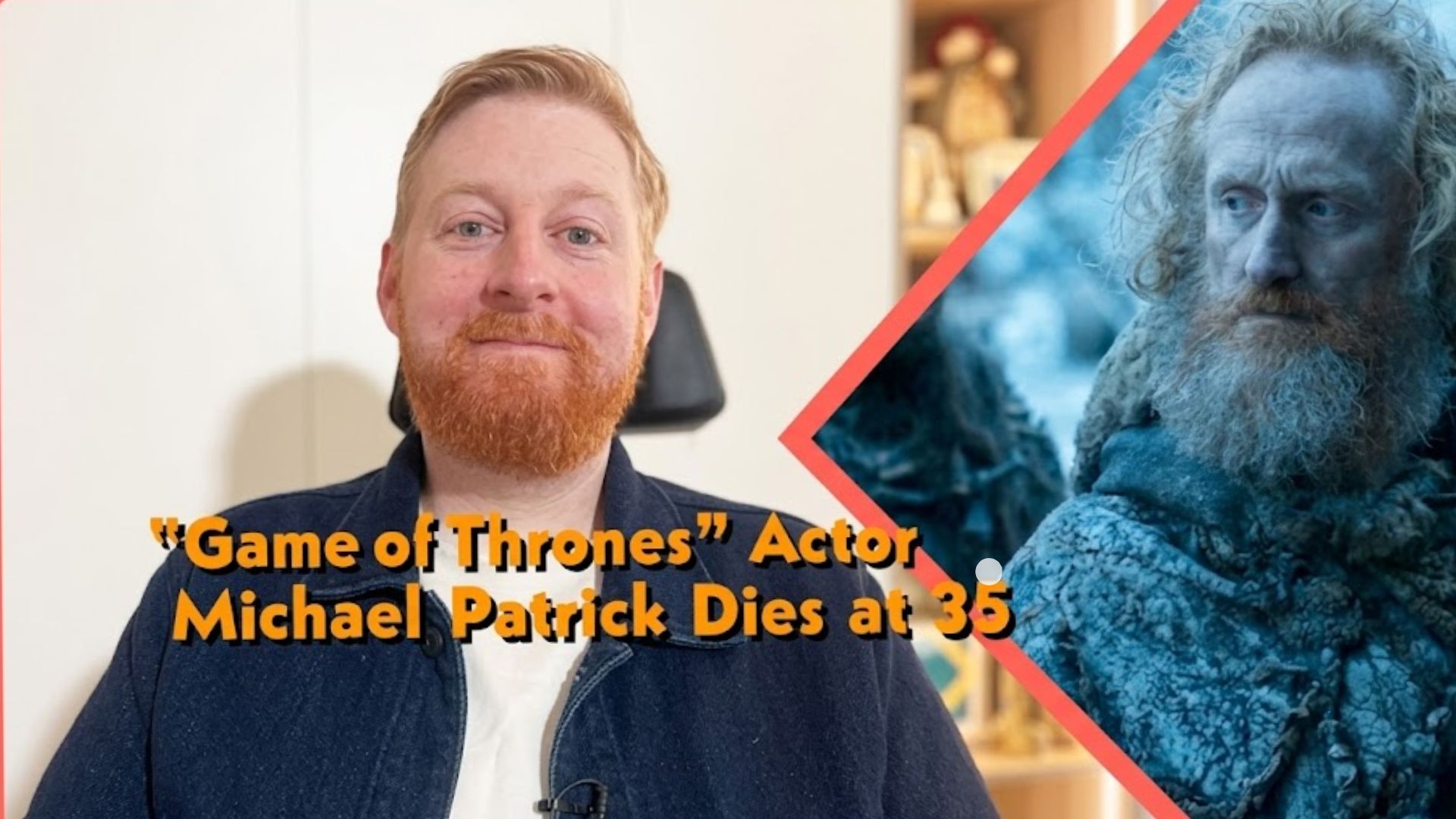
Introduction
Michael Patrick– being remembered after a tragic death at 35 has left fans with a heavy heart because some losses feel unfair the moment you hear them. There is sadness, of course, but there is also disbelief. Thirty-five is an age when life is still supposed to be opening up, not closing down.
It is an age when an actor is often finding more confidence, more opportunities, more range, and a deeper connection with audiences. That is part of why the story of Michael Patrick is touching so many people right now. His passing does not feel like the end of a long and complete public life. It feels like the interruption of a journey that still had so much ahead of it.
For a lot of people, the name Michael Patrick may first connect to Game of Thrones, one of the biggest television shows the world has seen in recent decades. Even a brief appearance in a cultural giant like that can stay with audiences because Game of Thrones built a massive emotional and global fan base.
But once people began reading about Michael Patrick after the tragic news, many realized that he was much more than a single screen credit. He was an actor with a real stage presence, a performer with range, a writer, a husband, and by all accounts a deeply admired human being whose courage in the face of illness made his story even more moving.
What makes this loss especially painful is that Michael Patrick was not only dealing with the normal uncertainty of an actor’s life. He was also facing motor neurone disease, an illness that changes everything for a person and for everyone who loves them.
And yet, from what has been publicly shared, he continued to create, continued to perform, and continued to live with dignity and spirit. That changes how people understand his story. This is not just a celebrity death item. It is also a human story about talent, resilience, love, and a life that held meaning far beyond public fame.
When someone dies young, people often rush to summarize them too quickly. They turn a person into a label, a headline, a role, or a public moment. But Michael Patrick deserves something fuller than that.
He deserves to be remembered not only as an actor connected to a famous series, but as someone who worked seriously across stage and screen, who brought his own experiences into creative work, and who seems to have inspired people around him through the way he faced hardship.
That is why this article matters. It is not only about the fact of Michael Patrick’s death. It is about why people are mourning him so deeply, what made his career meaningful, how his Game of Thrones appearance became a doorway for many fans to learn about him, and why his life story now feels larger than one performance. The sadness around Michael Patrick is not only because he was talented. It is also because he appears to have been brave, warm, committed to his craft, and still moving forward when life had every reason to make that difficult.
| Key Detail | Information |
|---|---|
| Main Keyword | Michael Patrick |
| Why He Is in News | Michael Patrick is being remembered after his death at 35 |
| Best Known For | His appearance in Game of Thrones and a growing career across screen and stage |
| Personal Story | He faced motor neurone disease with courage and continued to work |
| Why This Story Matters | Fans and colleagues are mourning a talented actor whose life ended far too soon |
Why Michael Patrick’s Death Feels So Heartbreaking
The death of Michael Patrick feels especially heartbreaking because it carries the kind of sadness that is impossible to separate from age and circumstance. When someone passes away at 35, the public does not only mourn who they were. It also mourns who they still could have become. That is the deepest ache in stories like this. People do not just grieve the life that was lived. They grieve the future that now no longer exists.
In the case of Michael Patrick, that pain is made even stronger by the fact that he had been living with motor neurone disease. An illness like that changes how people experience a public story. The sadness becomes more layered. There is sympathy for the suffering, admiration for the strength, sorrow for the family, and a quiet emotional shock at how cruel life can be. When readers learn that he kept working and creating despite this diagnosis, the loss becomes even more powerful because it no longer feels like the story of someone fading away from view. It feels like the story of someone who kept holding onto purpose.
There is also a very human reason this story is hitting people hard. Audiences respond deeply to performers who seem sincere. Not every actor becomes that kind of figure. Some are admired from a distance. Some are famous in a polished way. But there are others who feel real, vulnerable, and grounded. From everything that has emerged after his death, Michael Patrick seems to have been that kind of person. He did not appear to be remembered through glamour or noise. He was remembered through affection, respect, and the sense that he had real substance.
That tone matters. It changes the emotional climate of the story. Instead of a loud entertainment headline, the public is reacting to something quieter and more painful. It feels like the loss of a genuinely admired artist. And when the person lost is still young, still working, and still loved, the sadness spreads beyond those who knew him personally. It reaches fans, colleagues, theater people, television audiences, and even casual readers who may never have followed his career before.
Another reason the story feels so painful is because it reminds people how fragile life is even for those who seem to be rising. In the entertainment world, people often think in terms of momentum, upcoming roles, and future recognition. A performer in their thirties can still feel like someone whose biggest breakthrough is just around the corner. The death of Michael Patrick interrupts that imagined arc. It forces people to confront how much can disappear even when promise is still growing.
The result is a grief that feels very raw. It is not only sadness. It is sadness mixed with injustice. Fans and colleagues seem to be reacting not just to the fact that Michael Patrick has died, but to the feeling that he should have had much more time.
Michael Patrick and the Game of Thrones Connection
For many people, the first reason the name Michael Patrick drew attention was his connection to Game of Thrones. That show remains one of the most widely known and emotionally powerful television series in recent history. It became more than a fantasy drama. It became a global event. Because of that, any actor associated with the series instantly enters a wider public awareness than they might through smaller projects alone.
That connection matters because it created the first bridge between Michael Patrick and a large international audience. Even if his role was not one of the central long-running characters, appearing in Game of Thrones placed him within a world that fans still care about deeply. The series has a way of keeping even smaller roles alive in the public imagination because viewers remain intensely attached to its world, its cast, and its legacy.
But the Game of Thrones link also does something else. It gives casual readers an easy way into his story. A lot of people may not immediately recognize every actor from theater or British and Irish television, but once they hear “actor from Game of Thrones,” they stop and pay attention. That is part of why the tragic news about Michael Patrick spread so widely. The show gave the public a familiar reference point.
At the same time, it is important not to reduce Michael Patrick only to that credit. The danger with very famous franchises is that they can shrink a person’s identity in the public eye. An actor becomes “that person from that show,” even when their real career is far broader. In Patrick’s case, that would be unfair. The Game of Thrones appearance was meaningful because it connected him to millions of viewers, but it was not the entire story of who he was or what he brought to acting.
Still, there is no denying the emotional power of that connection. Fans of Game of Thrones feel a particular bond with performers from that universe because the series itself became such a huge shared experience. It brought people together across countries, generations, and types of viewers. So when they hear that Michael Patrick has died at 35, they feel more than passing recognition. They feel the loss of someone connected to a world they cared deeply about.
That is why the phrase “Michael Patrick of Game of Thrones” carries such weight. It is not merely a media shortcut. It is the point where a personal tragedy becomes legible to a global audience. It is the doorway through which many people began learning about a much larger, much sadder story.
More Than One Role: The Career Beyond the Headlines
One of the most important things to say about Michael Patrick is that he was never just a single credit. The public may first pause because of Game of Thrones, but anyone who looks at his wider career sees a fuller picture of an actor who was steadily building meaningful work across screen and stage. That matters because his legacy deserves to be understood in complete form, not as a one-line reference to a famous series.
Michael Patrick’s work across different productions showed that he had range. He was part of a generation of performers who move between television, theater, and writing without treating one medium as more “real” than the others. That kind of career path says a lot about artistic seriousness. It means the person is not simply waiting for fame. It means they are committed to craft wherever the work appears.
That is one reason Michael Patrick now seems to be mourned so warmly within acting circles. Working actors understand how hard it is to build a body of work one project at a time. They know what it means to keep showing up, to keep earning trust, and to keep creating even when attention is not guaranteed. When such a performer dies young, the grief can feel especially personal among peers because they recognize the amount of unseen labor behind every visible role.
There is also something deeply admirable about an actor who is not boxed into one tone or one format. Michael Patrick appears to have worked in ways that reflected versatility. He was not just passing through an industry machine. He was contributing to different types of storytelling. That breadth helps explain why the response to his death has not been narrow or limited to one fandom. People from different corners of the performance world have reasons to feel his absence.
Another meaningful part of his career is that he was not only acting in work created by others. He also had a connection to writing and storytelling from a more personal place. That suggests imagination, honesty, and a willingness to make art from lived experience. Audiences and colleagues often feel especially close to artists who do that because it reveals something more vulnerable than simply taking a role.
The tragedy of Michael Patrick is therefore not just that a known actor has died. It is that a growing artist with clear depth, serious training, and a widening creative life has been lost. His story matters because it shows how much there was already and how much more there could have been.
The Stage Actor Behind the Screen Presence
Although many readers first recognize Michael Patrick through television, his work on stage seems to have been central to his identity as an actor. This is important because theater demands something different. It asks not only for talent but for discipline, control, stamina, and the ability to create emotional truth live, without cuts, second takes, or camera tricks. Actors who thrive there usually carry a deeper kind of respect among peers.
This stage background helps explain why so many tributes feel personal and full of admiration. Theater communities often know one another in more intimate ways than screen audiences do. Rehearsal rooms, live performances, touring, and repeated collaboration build a kind of closeness that is hard to fake. If Michael Patrick was loved and respected in those spaces, that says a lot about the man behind the public credits.
His connection to major stage work also matters because it reveals craft. Screen fame can sometimes arrive quickly, but stage credibility usually comes through hard-earned trust. It is built through the voice, the body, the ability to handle language, the ability to hold a room, and the willingness to keep refining performance. When an actor moves through Shakespeare and serious theater work, audiences instinctively understand that they are looking at someone with substantial skill.
There is also something emotionally powerful about thinking of Michael Patrick on stage while facing illness. The image of a performer continuing to step into demanding roles despite a devastating diagnosis creates a feeling that goes beyond admiration. It becomes inspiration. It tells people that the artist in him remained alive and determined. He was not defined only by his disease. He continued to be who he was meant to be.
That matters because death stories can sometimes flatten a person into suffering. But Michael Patrick’s story resists that flattening. Yes, illness was part of his final chapter. But so was work. So was creativity. So was the decision to keep performing. That means the public memory of him is not only tragic. It is also dignified and deeply moving.
The theater side of Michael Patrick therefore adds richness to how he is remembered. It shows that beneath the recognizable television credit was a serious actor with real stage roots, real discipline, and the kind of artistic identity that leaves a mark on colleagues as well as audiences.
Training, Education, and the Making of an Artist
Every actor brings some natural instinct to performance, but the ones who endure usually build that instinct through training, discipline, and study. In the case of Michael Patrick, his educational and artistic background helps explain the depth people seem to associate with him. He was not simply someone who drifted into acting. He appears to have shaped himself deliberately into a performer.
That kind of path matters because it tells us something about intention. An actor who studies, trains, and grows through recognized creative environments is often someone who takes the work seriously at its core. They are not only chasing visibility. They are trying to become better. That effort may not always be visible in headlines, but it becomes visible in the quality of the work and in the respect that follows.
For Michael Patrick, his training background also helps explain how he could move between stage and screen without seeming misplaced in either. That kind of flexibility usually comes from a strong foundation. It suggests not only talent but technical understanding. He seems to have been part of that tradition of actors who can bring intelligence as well as emotion to a role.
There is also a personal sadness in knowing that so much time and care had gone into forming his artistic life, only for that life to be cut short. When a performer dies young, people often think about promise. But in cases like this, it is not only future promise that hurts. It is also the realization that someone had already spent years building something meaningful and still had so much left to deepen.
This is another reason the loss of Michael Patrick feels different from a passing celebrity news item. There is a sense of real craft behind the career, real learning behind the performances, and real purpose behind the path. The grief feels larger because it is not just the loss of a face from television. It is the loss of a trained, thoughtful artist whose journey was clearly still unfolding.
In that way, his educational and artistic background makes the tragedy sharper but also fuller. It reminds people that they are mourning not only a performer with talent, but a performer who worked seriously to become what he was.
Michael Patrick as Writer and Storyteller
What makes Michael Patrick especially interesting as an artist is that he was not limited to performance alone. He also had a connection to writing and storytelling in a more personal sense. That matters because writing reveals a different part of a creative person. Acting allows someone to embody stories shaped by others. Writing asks them to expose their own voice.
This side of his work makes the public memory of him richer. It suggests that he did not see creativity only as a matter of auditioning and appearing on screen or stage. He seems to have had something to say from within his own experience. That is often a sign of a deeper creative hunger. It means the person is not only interpreting stories. They are also trying to shape them.
There is something especially affecting about artists who draw from their own lives. It usually involves courage. It asks them to look inward and trust that something personal can become meaningful to others. In the case of Michael Patrick, this adds another layer to how people are grieving him. They are not only remembering roles he played. They are also remembering a storyteller who brought something of himself into the work.
This matters more after death than it might have while the person was alive, because it changes how the legacy is read. A performer who only acts leaves behind characters. A performer who also writes leaves behind traces of their own inner world. That makes remembrance more intimate. It allows people to feel closer to who the person actually was.
It also increases the sense of loss. When an actor dies young, we mourn future performances. When a writer-performer dies young, we also mourn the stories that never got written. That is part of the silent grief around Michael Patrick. There is not only a career cut short. There is a voice interrupted.
In this way, his writing side deepens the human sadness of the story. It tells us that his creativity was not one-dimensional. He had more to give than audiences may even have fully seen.
Living With Motor Neurone Disease and Refusing to Vanish
Any honest remembrance of Michael Patrick must include the extraordinary challenge he was facing in the final years of his life. Motor neurone disease is not a small obstacle. It is a devastating diagnosis. It brings fear, uncertainty, physical change, emotional strain, and the knowledge that life has shifted in a fundamental way. For a performer, whose body and voice are central tools of expression, the cruelty can feel even sharper.
That is why people are speaking of Michael Patrick with such admiration. It appears that he did not simply retreat from life and work after the diagnosis. He continued to create. He continued to perform. He continued to move through the world not only as a patient but as an artist. That decision gives his story a very different emotional texture. It becomes not only a story of illness, but one of resistance.
There is something deeply moving about that kind of courage because it is not loud or theatrical in the wrong sense. It is quiet courage. It is the courage of continuing. Of not surrendering the self entirely to the disease. Of saying, in action if not always in words, that the artist within you still deserves to exist.
This is a major reason the death of Michael Patrick is creating such an emotional response. People are not simply reading about someone who suffered. They are reading about someone who kept living with meaning while suffering. That difference changes everything. It creates respect alongside grief.
It also turns his story into something larger than entertainment news. Illness can strip away illusions. It shows what matters. In Michael Patrick’s case, what seems to have mattered was love, craft, persistence, and dignity. That is why the story feels so human. It speaks to something universal. The fear of illness, the hope of continuing, the wish to remain yourself in hard circumstances, and the love of those who stay beside you.
In the end, the illness is part of the story, but it is not the whole story. The deeper truth is that Michael Patrick seems to be remembered because he did not let illness entirely define him. He kept creating, and that is part of why people now remember him with such tenderness.
The Love Story Behind the Public Grief
Whenever an actor dies young, public grief can become very visible very quickly. But what often gives that grief its deepest human shape is the presence of family, especially a partner whose words remind everyone that the person in the headlines was also someone’s entire world. In the case of Michael Patrick, the public reaction has been shaped strongly by what has been shared about his wife, Naomi Sheehan, and the love surrounding his final days.
That element matters because it pulls the story away from abstraction. Readers no longer see just an actor, a credit list, or a tragic diagnosis. They see a man loved intimately and mourned closely. That always changes the emotional weight of a public loss. It becomes easier to imagine the real silence that follows, the empty spaces at home, the private grief behind the public tribute.
The way a loved one speaks after a death also tells the public something about the person who has been lost. In this case, the tone of remembrance around Michael Patrick suggests tenderness, admiration, and gratitude alongside heartbreak. Those emotions say a lot without needing grand claims. They tell us that his life was not only professionally meaningful. It was personally cherished.
This is another reason the story hurts so much. When audiences sense that a person was deeply loved, their own grief becomes fuller. They recognize that the tragedy is not only cultural or professional. It is deeply domestic and human. It belongs to a family, to friendships, to a circle of people whose lives have been permanently changed.
The love story within the grief also gives Michael Patrick’s memory a kind of warmth. Even in sadness, there is beauty in knowing that someone left this world surrounded by care. That does not erase pain. But it softens the harshness with dignity. It reminds the public that while his life was too short, he was not alone at the end.
And in some ways, that becomes part of how Michael Patrick will be remembered. Not only as a performer who worked bravely, but as a man deeply loved by those closest to him.
Why Fans Who Never Met Him Still Feel the Loss
One of the most fascinating parts of public mourning is how deeply people can feel the death of someone they never actually met. This is especially true in acting, where audiences form emotional connections through performance, interviews, public stories, and the sense of personality that comes through work. In the case of Michael Patrick, that connection seems to be happening in a very sincere way.
Some of it comes from recognition. Fans remember Game of Thrones and feel a bond through that universe. Some of it comes from admiration after reading about his courage and illness. Some of it comes from the way his story speaks to something larger than fame. It is about youth, struggle, art, and dignity. Those themes reach people quickly because they are deeply human.
There is also a kind of tenderness in how working actors are often mourned. Superstars can sometimes feel distant. But actors who seem grounded, talented, and still in the building stage of their careers can feel more relatable. People see their effort more clearly. They feel the fragility of the journey. The loss of Michael Patrick therefore hits people not only as the death of a known face, but as the loss of someone who seemed real.
Public grief also intensifies when a story contains both tragedy and courage. If a person suffered, but also fought to keep creating, audiences often respond with real emotional warmth. They do not only feel pity. They feel respect. That combination of sadness and admiration is powerful, and it is clearly shaping the reaction to Michael Patrick’s death.
In a deeper sense, fans feel this loss because art always creates strange forms of closeness. A performance can make an audience member feel seen, moved, startled, or comforted. Even a brief role can stay in the mind if the larger emotional world around it is strong. Over time, that becomes a quiet bond. So when the person behind the work dies, grief appears even among strangers.
That is why Michael Patrick is being mourned beyond his personal circle. The work created connection, and the story of his life deepened it.
The Cruelty of Talent Cut Short
One of the reasons stories like this remain in the public mind is because they force people to confront a painful truth: talent does not guarantee time. In many careers, especially creative ones, people assume the journey will continue to grow with age. An actor in their thirties is often just stepping into a richer phase of work. They have more experience than before, more emotional depth, and usually more control over their craft. That is why the death of Michael Patrick feels not only sad but cruel.
He was not being remembered as someone long retired or long removed from the work. He was remembered as someone still in motion. That is a different kind of tragedy. It carries the sense of interruption. The future disappears, and along with it all the performances, stories, collaborations, and roles that now will never happen.
This is the deeper ache under public tributes. People are not only honoring what Michael Patrick did. They are imagining what he still might have done. That imagination is a painful thing, because it has nowhere to go. It remains only as a sense of lost possibility.
In creative fields, this kind of loss can feel especially intense because artists do not always reveal their full range early. Many only begin to produce their most powerful work later, after years of learning and living. That means the death of a talented actor at 35 always carries a secondary grief: the sense that something unfinished has been taken away.
The public feels that with Michael Patrick because everything about his story suggests growth, seriousness, and momentum. He was not a fading figure from a single old role. He was a living artist still adding to his body of work. That makes the silence after death feel bigger.
It is one thing to lose someone after a full and visibly completed life. It is another to lose someone while the future is still visibly open. Michael Patrick’s story carries that second kind of heartbreak, and that is why it lingers so painfully.
Why This Loss Feels Bigger Than Entertainment News
At first glance, some readers might think this is simply another entertainment story, another obituary for an actor known from a famous television show. But the reason Michael Patrick is being remembered so deeply is that the story does not stay inside entertainment for very long. It moves quickly into larger human territory.
It becomes a story about illness and courage. About youth and mortality. About continuing to create under pressure. About the love of a spouse. About the dignity of meaningful work even when life becomes frightening. Those themes are much larger than celebrity culture. That is why readers who may not even have followed his career closely still find themselves moved.
This is also why the story feels different from ordinary fame-driven coverage. There is less noise around scandal or glamour and more focus on character, resilience, and affection. That gives the tribute a different emotional shape. It invites respect rather than mere curiosity.
In that sense, the public mourning of Michael Patrick becomes a reminder that the entertainment world is still full of real people whose struggles and losses can touch audiences in unexpectedly deep ways. Sometimes a death story reaches further not because the person was the most famous, but because the human truth is clearer.
That clarity is what makes this loss feel bigger. Michael Patrick’s story is not important only because he acted. It is important because he seems to have lived with real courage, real love, and real dedication to his craft. That is something people respond to instinctively.
So no, this is not just entertainment news. It is a story about a young life, an artist’s persistence, and the kind of quiet bravery that leaves a lasting impression.
Final Thoughts
The story of Michael Patrick being remembered after a tragic death at 35 is painful because it holds so many layers at once. It is the loss of a young actor. It is the loss of a husband. It is the loss of a performer with stage discipline, screen presence, and creative range. It is the loss of someone who faced serious illness and still continued to work. And perhaps most painfully, it is the loss of someone whose future still felt wide open.
For some readers, Michael Patrick will always be tied first to Game of Thrones. For others, he will be remembered through theater, television, writing, or the courage of his final years. But whatever doorway brings people to his story, the feeling they leave with seems to be the same: sadness, admiration, and the sense that this was a life worth honoring properly.
There is something deeply human about the way Michael Patrick is being remembered. The tributes do not suggest an empty celebrity image. They suggest a real artist and a real person. Someone who worked seriously. Someone who was loved. Someone who kept going. That is why the grief around him feels sincere.
In the end, perhaps that is the most meaningful legacy any artist can leave behind. Not just work that people watched, but a life that people respected. Not just roles, but character. Not just recognition, but warmth in the memory of others.
Michael Patrick’s life was too short. There is no soft way around that truth. But within that painful truth, there is also something worth holding onto. He mattered. His work mattered. His courage mattered. And that is why he is being remembered with such real emotion now.
FAQs
Who was Michael Patrick?
Michael Patrick was an actor known for his appearance in Game of Thrones as well as work across stage and screen. He was also remembered as a writer and as a performer admired for his dedication and courage.
Why is Michael Patrick in the news?
Michael Patrick is in the news because he died at the age of 35, and fans and colleagues are mourning his passing while reflecting on his career and personal strength.
What made Michael Patrick’s story so emotional?
His story feels especially emotional because he died young, had been living with motor neurone disease, continued to work through illness, and was remembered with deep love and respect by those around him.
Was Michael Patrick only known for Game of Thrones?
No. While many people recognize Michael Patrick because of Game of Thrones, he had a broader career across theater, television, and writing.
Why are fans reacting so strongly to Michael Patrick’s death?
Fans are reacting strongly because Michael Patrick was seen not only as a talented actor, but as someone who showed courage, humanity, and commitment to his art even during very difficult circumstances.